Print your photo as a canvas you can actually paint.
Upload a photo and we turn it into a numbered outline. Download it as a print-ready file, then fill it in with real paint on real paper.
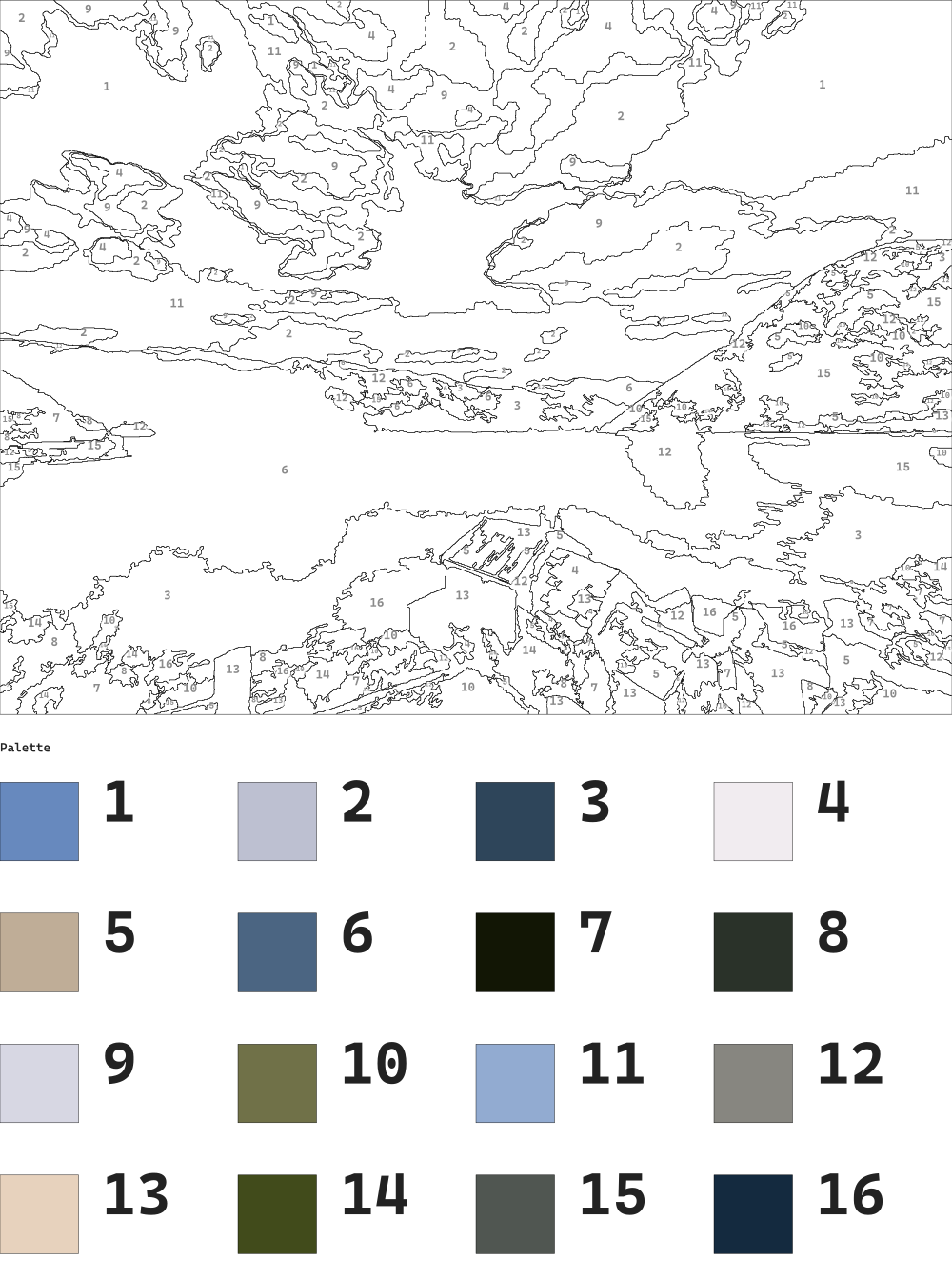
What lands in the file
It all arrives in one fileThe numbered outline
Black contours, grey numbers, white paper. Every region is numbered, including the thin ones.
A colour key
Each number with its swatch, and how much of the painting that colour covers.
A paint-mixing guide
Each colour written as a recipe you can mix from tubes you already own.
A shopping list
Every paint you need, named by the pigment code printed on the tube.
This is a file, not a kit.
We do not sell or ship anything physical. No box of paints, no brushes, no pre-printed canvas. You download the file, print it on your own printer, and buy paint wherever you normally would.
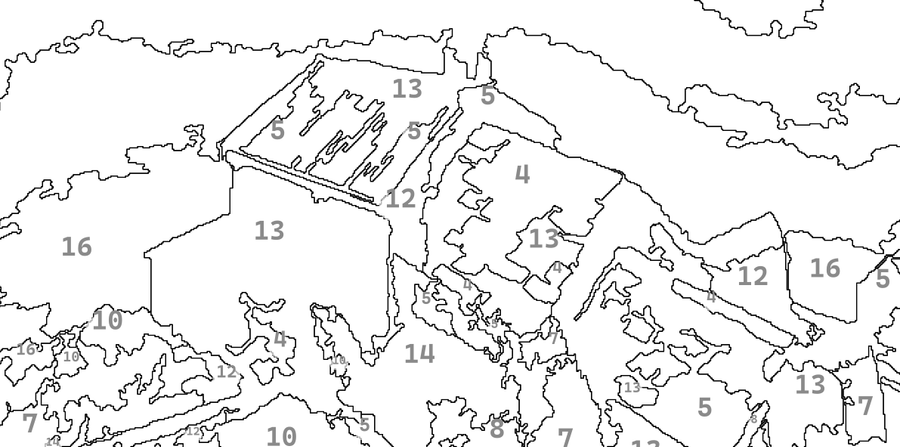
Big canvases print on the printer you already have.
Format and size- Laid out to your paper size with margins and a separate palette sheet. Open it and hit print.
- PNG
- One high-resolution image, no page layout. You scale it.
- SVG
- True vector, sized in millimetres, with the artwork, legend and numbers on separate layers. For plotters, cutters, and anyone who wants to edit it.
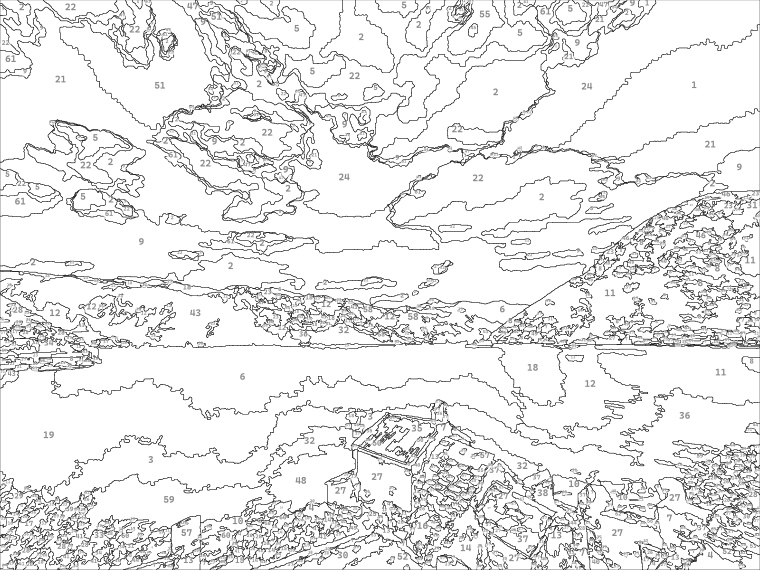
A2 prints as 4 A4 sheets you tape together — no large-format printer.
Which size to pick
Detail level matters more than paper size. Each suggestion below is the highest level that keeps most regions big enough for a full-size number, measured on the example canvas.
For children, and for finishing in one sitting. Plain paper, coloured pencils, crayons or felt tips.
Suggested level: Sketchy
Even at the lowest level 27% of regions print cramped here. A5 suits simple pictures.
The everyday print. Pencils and markers on copy paper; gouache or acrylics if you print on 120 gsm.
Suggested level: Sketchy
At that level 6% of regions still print cramped.
Room for a brush. Heavy paper or board, acrylics, and a small round brush for the thin regions.
Suggested level: Easy
At that level 15% of regions still print cramped.
The grown-up canvas. Transfer the outline onto stretched canvas and paint it over a few evenings.
Suggested level: Medium
At that level 9% of regions still print cramped.
It tells you before you waste the paper.
Before you print595 of 963 zones are very small — their numbers may be unreadable when printed at this size. A2 makes them easier to read.
We measure it before you print. The sheet we suggest is the smallest one that actually helps, which is often two sizes up.
Share of regions too small to hold a legible number, measured on this painting.
Every colour, written as a recipe.
The mixing guide≈ approximate match — mix and adjust by eye
The recipes come from a pigment mixing model rather than from blending colours on a screen, so they behave the way paint behaves — white lightens, and almost everything else mixes darker.
Pick a six, twelve or eighteen tube set, and every colour in the painting is rewritten as a mix of those tubes.
With 6 tubes, 6 of this painting's 63 colours come out as an approximate match.
Why pigment codes
PB29, PY35, PW6 — the codes printed on the tube itself. PB29 is ultramarine whoever made it, so the list works at any brand and any price.
Four ways onto stretched canvas.
From paper to canvasGraphite transfer paper
The default. Slide a graphite sheet under the print and trace the contours onto the canvas.
The grid method
Rule the same grid on both, then copy the shapes square by square. Slow, but it costs nothing.
A projector
Throw the outline onto the canvas at whatever size you like and draw over it.
Iron-on transfer
Press a printed transfer down with an iron. The download has a Mirror option that flips the artwork so it lands the right way round.
Most bad prints come down to one of these.
Do
- Print at 100% — "actual size", not "fit to page".
- Use 120 gsm paper or heavier if you are painting on it wet.
- Print the palette page in colour.
- Pick a bigger sheet for a detailed painting.
- Choose a lower detail level if you know you will print it.
Avoid
- Leaving "fit to page" scaling switched on.
- Acrylics on thin copy paper.
- Printing the palette in greyscale.
- Cramming a very detailed canvas onto one A4.
Before you start.
Does printing cost extra?
No. Credits are spent once, when you create the painting. After that you can download and print it as often as you like, in any format and at any size. There is no Pro requirement.
Do I need a special printer?
No. Every page we produce is A4, so even an A2 canvas prints as four A4 sheets you tape together.
PDF, PNG or SVG?
PDF for printing. PNG if you want the raw image. SVG if you want vector layers to edit or cut.
What paint should I use?
Acrylics are the easy default. The download can include a mixing guide for a six, twelve or eighteen tube set.
Can I paint on real canvas instead of paper?
Yes. Transfer the printed outline with graphite paper, a grid, a projector or an iron-on transfer.
Why are some numbers so small?
Detailed paintings pack many small regions onto the page, so their numbers shrink to fit. Print a bigger sheet, or make a lower-detail version for printing.
Turn a photo into something you can hold.
Free credits to start, and the print itself costs nothing.
Upload a photoWe do not print or ship anything — the file is yours to print.